
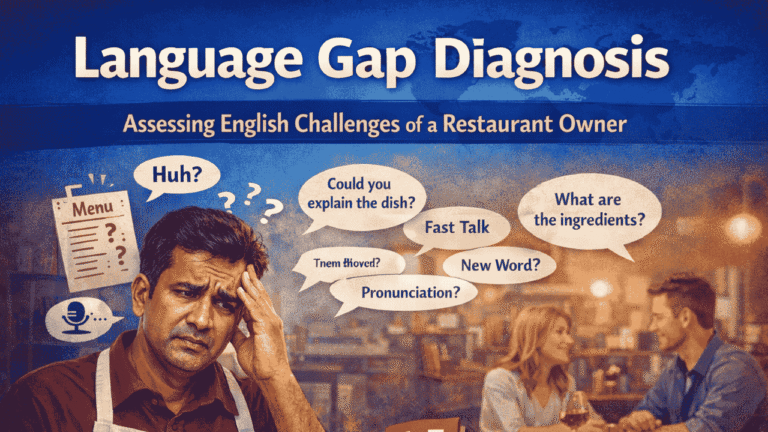
Context of the Interview
This language gap diagnosis is based on an interview conducted with a restaurant owner at a local restaurant. The interview was originally conducted in Urdu, and the responses were later transcribed into English. The purpose of the interview was to identify the English language difficulties he faces in his professional environment and the specific areas he wants to improve.
Interview Questions and Responses
1. What kind of work do you do, and where do you use English in your job?
The participant stated that he runs a restaurant and primarily uses English while dealing with customers, reading menus, and communicating with suppliers.
2. Do you feel comfortable speaking English with customers? Why or why not?
He reported that he does not feel fully comfortable speaking English because he often forgets words and becomes nervous during conversations.
3. What type of English tasks are most difficult for you at work?
He mentioned that explaining menu items and answering customer questions in English are the most challenging tasks.
4. Do you face problems understanding customers when they speak English?
He shared that he sometimes struggles to understand customers when they speak quickly or use unfamiliar vocabulary.
5. How confident are you while speaking English at work?
He described his confidence level as average but admitted that he feels shy when customers speak fluently.
6. What specific language skills would you like to improve?
He expressed a strong desire to improve his speaking and listening skills.
7. Do you think pronunciation is a problem for you?
He confirmed that pronunciation is a challenge and feels customers sometimes struggle to understand him.
8. Have you ever learned English formally?
He shared that he studied English in school but never practiced speaking regularly.
9. What situations make you feel stressed while using English?
He reported feeling stressed when dealing with foreign customers or when multiple customers are waiting.
10. What strategies do you currently use when you cannot express something in English?
He explained that he uses gestures, simple words, or asks colleagues for assistance.
11. How important do you think English is for your professional growth?
He believes English is very important because it helps him communicate effectively and grow his business.
12. What are the main things you would like to polish in your English?
He wants to improve fluency, food-related vocabulary, and confidence while speaking.
Conclusion (Personal Opinion)
In my personal opinion, this interview clearly highlights the language gap in professional settings that many workers face in real-life environments. During the interview with the restaurant owner, I observed that his main difficulties were related to English speaking fluency, understanding fast spoken English, pronunciation, and professional vocabulary. These challenges often affected his confidence while communicating with customers, especially foreign visitors. I also noticed that although he had basic knowledge of English from school, he lacked consistent practice in real-life communication situations.
I believe these challenges can be improved through practical and consistent learning strategies rather than focusing only on grammar rules. First, speaking fluency can be developed through daily practice, such as role-plays with colleagues, confident conversations with customers, and short speaking exercises. Second, listening skills can be improved by regularly listening to English podcasts, restaurant-related videos, and customer interaction recordings. This approach can help him better understand different accents and fast speech.
Moreover, pronunciation challenges can be addressed by using mobile applications, watching pronunciation tutorials, and repeating words after native speakers. Learning professional vocabulary is also essential; he can maintain a small notebook of food-related words and phrases and review them daily. In addition, confidence can be improved through gradual exposure to English-speaking situations and by reducing the fear of making mistakes.
Overall, with consistent practice, exposure to authentic communication, and a positive learning attitude, the restaurant owner can successfully bridge his language gap and communicate more effectively in his professional environment.